Monday, November 10, 2003

September 20, 2003 --- Chimoio, Mozambique

Lucky Bean of Life Game

Take one bean in the palm of your right hand. Clasp it lightly. Close your eyes. Imagine the things that you would like to come to pass in your life. Open your eyes and smile. Then, with a light touch, cast your bean upon the board. Take note of where it lands. If it lands in one of the areas indicated by an illustration – dreams, treasure, family, children, travel, love – you will have luck in that area. You have three casts of the bean. If all your casts land between the areas of good luck, don’t worry. It’s simply the same as ever – you have to go on making your own luck !! Good luck!


Mixed-Up Recipe Game

This game is ideal for any adult for whom the kitchen is a dangerous no man’s land. Find a recipe for something fairly simple. For example, it could be something as simple as pancakes, but you have to name it something else just in case someone has cooked this dish before. List the steps. Number them. Then scramble them. Print them in all their disordered glory on a recipe card. Then mix them up with ten other mixed-up recipes. Have the player draw a card. He or she must figure out how to make the item, and will be given an opportunity to show how accomplished he or she is as a chef (or as a cooking forensicist!). Give all the competitors the same amount of time, and the same setup. Let them try to cook what is on the recipe card. Advise them that they follow the steps at their own peril!!

After all the fun is over, gather up all the donated recipes, unscramble them, then publish them in a book. You may even wish to publish pictures of the “creations” made by the “winners.” (Be sure to get their permission first to avoid lawsuits or domestic disputes.) You may wish to keep the original names for them. For example, cakes containing vanilla could be “Vanilla Vibe,” cookies containing red and yellow food coloring could be “Sunny Side of Life.”


Dogs of Chimoio Business Risk Game


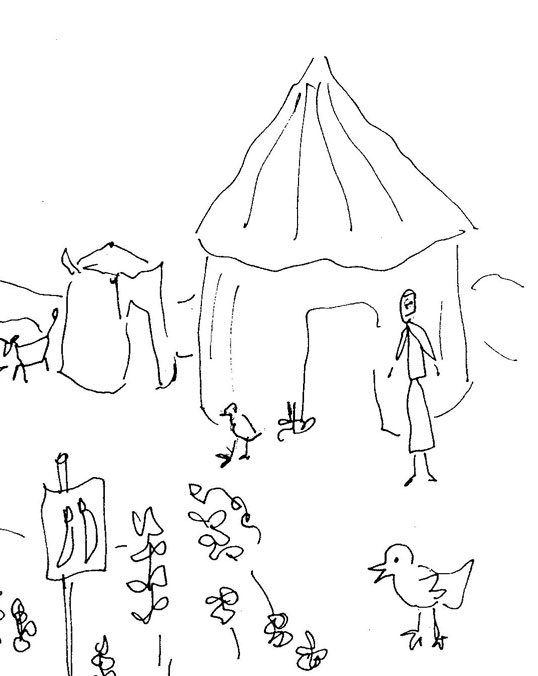
Puki, the happiest dog of Chimoio, wants to start up a little garden and marketing business. He’s not sure how to start, so he buys a package of paprika seeds, tomato plants, pepper plants, lettuce, and some packaging, boxes, and other items for selling them. He shares an orange Fanta at O Sitio with his best friends, Rui, Rauf, Rokcelo, and Marquitos. They like his idea and decide they want to do the same. So, they embark on their journey. Whoever ends the game with the most dinheiro and prize items is the winner of the game. You roll the dice and land on different places. The steps you land on can be either lucky or unlucky. You can win bones, free trips on a collective transport vehicle, fertilizer, weed-killer, pest-killer – or, you can have attacks of bugs, of plant disease, be robbed, or have your crop washed away. You can also have the opportunity to borrow money, then sell your crops.


Things that can befall the Dogs of Chimoio

--attacks of bugs
--plant disease
--robbery
--flood
--stray dog attack

Good luck and prosperity things that can come to pass

--bones
--free trip on collective transport vehicles
--if fertilizer purchased and applied you double your crop yield
--if weed-killer purchased and applied you may triple crop yield
--if pesticide purchased and applied you may double crop yield

September 19, 2003 --- Chimoio, Mozambique


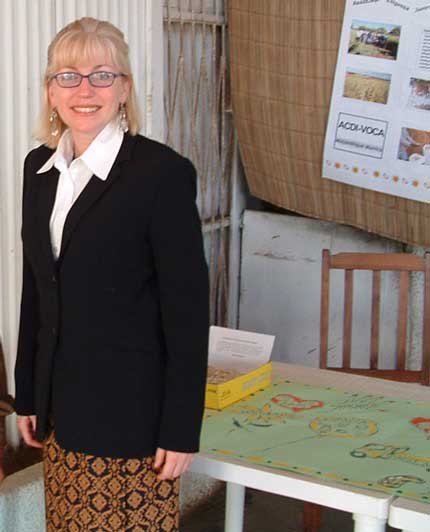
Today’s the big day. It’s the grand opening of the Agricultural Fair. The fair grounds are looking nice – fresh coats of paint, flowers, landscaping. The fair officially opens at 2 pm. We should have something in place by noon. I’m wearing a skirt, nice black jacket, and will wear mock-croc pumps. I’ll give the impression of respect needed if the Minister or Governor tours our booth. I’m amazed at how long it takes to construct a couple of posters if you have to do so many things that it turns what should have been a 2-hour project into something taking three days.

--find the images in image libraries and process them
--find new ink cartridges
--build all original clip art, optimize them, then print them
--do everything in Portuguese
--print out all labels, then print them out
--buy scissors and glue sticks to be able to cut & stick to poster board
--buy special poster board

This is not to mention the first and foremost challenge, which is to try to figure out what on earth the posters are supposed to be about, and what the project itself is about. Lifting text from the annual report was inspired. Still, I’m trying to throw up as many smoke screens as possible to distract people, and keep them from looking too closely at the quality of the posters. How do you do a layout when you don’t have a flat surface, t-squares, ruler, triangles, Xacto knives… in essence, NOTHING that normal drafting offices would have (10 years ago). Ahhhh – the joy of challenges. “Hand-crafted” is what we can say about these posters.


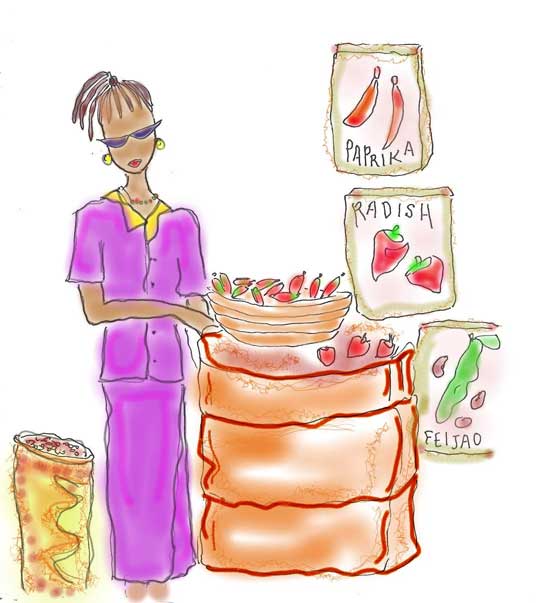
Yesterday, we had three visiting association heads in the office. They were quickly put to work drawing smiley faces on white kidney beans. “Feijao da boa sorte” – feijao magicos … but I guess you can’t say that. I drew a few beans with fangs. They looked surprisingly menacing. Everyone wanted to throw a few of those into the mix, but it was overruled.

“Only happy, smiley faces!” Hey, I can do that. In fact, I can become a bean myself and keep smiley face affixed. It has become an existential condition. Grrrr.

I’m still not completely convinced that this will not be a complete disaster. The board onto which guys will throw the beans to see where they have good luck has the following categories –

--amor
--familia
--crianca
--prosperidade
--viagem
--sonho

Other stuff. So, all in all, we’ll have the following stuff to put up –

--posters
--flyers
--report
--beans and corn guessing game
--visitor’s book
--baskets
--cards
--Magic Bean Good Luck Game

Yeah. I feel like quite the wedding planner. I need some coffee.


September 14, 2003 -- Chimoio, Mozambique.


It’s cold and rainy. It’s 4:45 am and I’m wide awake – partially from time difference and jet lag, and partially because there are some roosters nearby that are crowing the dawn into being. It has been raining non-stop since around 5 pm yesterday afternoon. I suspect that by now, the dusty, clayey roads are thick with mud. I’m glad I brought clothes to jettison. I’m now wishing I had brought a few of the old sweatshirts I had put in the Habitat for Humanity donation box I put out on the front porch before I left. It’s surprisingly cold. It reminds me of Vermont in August, with the chill, damp breeze and surprisingly harsh sound of raindrops on tin, tile, or broad, flat leaves. I’m looking the clothes I brought with me. One jeans jacket. Lots of baggy, long-sleeved white cotton shirts I bought a few years ago at a sample shop. They are nice Nordstrom’s or Dillards-type brands, but they all have that late 90’s look that makes one appear instantly 20 pounds heavier. I can drape them over the baggy, fairly worn-out pants I brought with me, also suitable for jettisoning. Thankfully, there are no full-length mirrors in the immaculate bed and breakfast where I’m staying.

Dogs yelping and barking. Serious whining. Snake? They said the snakes stay away during the dry season. This is looking like the rainy season to me. It’s cold. Why are those dogs yelping? What is going on out there?

Thursday, October 23, 2003

Tuesday, July 22, 2003

Grading Standards for Writing Assignments in an Online Course

Susan Smith Nash, Ph.D.

In theory, living in the web world would lead to improved writing skills. After all, most of the communication is done through e-mail, discussion boards, instant messaging, and chat.

Most instructors of online courses point out that in many cases, just the opposite has occurred. Instead of fully formed thoughts supported by plausible evidence, the average paper becomes a sketchy affair written in a kind of e-mail-ese that consists of rants and choppy, disconnected thoughts, non-standard spelling, and pseudo-plagiaristic “borrowing” that manifests as unreferenced segments of online articles copied and pasted into the body of a paper.

In addition, it is important to help students come to realize that the standards for non-Internet-based writing should apply to Internet-based writing. Online courses should not have different standards than onsite or traditional courses. If anything, there should be higher standards, given that the writer is potentially writing for a larger audience who will read the work on the screen as well as on paper.

The first step in writing is learning how to organize one’s thoughts. Writing is all about thinking. It is not about mechanistic goose-stepping to grammar.

For an essay, such as those required in college first-year composition courses, the criteria may be summarized in the following manner:

Content: The essay reflects the original thought of the writer, centered around a central point, idea, or thesis. The idea and key terms are clearly defined, and the points are supported by relevant, credible, and referenced evidence. The concepts cover ideas from more than a single field or source, and cross disciplines.

Organization: The essay is organized in a manner that can be followed by the average reader. Whether the structure follows inductive or deductive logic is not as important as overall coherence of the argument. Each point is well-developed and balanced. Sentences are correctly constructed, and follow established norms of syntax and grammar.

Presentation: The presentation should be appropriate for reading on the screen or on paper. Ideally, paragraphs are short, font size is readable, and subheadings are used to cue the reader and organize the thoughts and points.

Diction: Word Choices and Tone: The essay contains word choices that are appropriate for the topic, with a tone that is appropriate for the audience and the subject matter. Wrong words and awkward constructions are avoided.

Mechanics: Grammar, Punctuation, Spelling: The essay follows the standard grammar, punctuation, and spelling of American English.

Citing Sources: Sources are cited in a consistent manner, following the conventions in an agreed-upon style guide. Citations are not presented in a back-to-back manner. The author’s original thoughts dominate, and citations serve to reinforce or support the primary thesis.

Because the standards are fairly subject to interpretation, it is important to provide examples of successful essays. However, there is a danger in this. The more insecure student will use the sample as a model and will not deviate from it. Such slavish adherence to the model of the sample essay leads to a less than ideal learning experience. Deep learning takes place when the individual makes connections between the subject of his or her essay and her own experience and life.

More useful is a template, guide or flowchart. This will help the student structure the initial draft, but does not constrain him or her in terms of subject, style, ideology, or overall tone.

The key to success is the human touch. The student will gain confidence as the instructor provides timely and relevant feedback. Instead of punishing and “correcting”, the instructor should guide and encourage intellectual risk-taking. Grading guidelines and standards are fluid and flexible. They are meant to be applied in an appropriate way that leads the student to introspection and deeper learning, in addition to enhanced skills in writing.


Saturday, July 05, 2003

RESEARCH PAPER SURVIVAL GUIDE
WEB-BASED RESEARCH AS A POINT OF DEPARTURE


Author: Susan Smith Nash, Ph.D.

GETTING STARTED
Developing your “Previous Work” section with web-based research forms the cornerstone of this approach to writing research papers. It may seem a bit formulaic to follow the steps presented below, but it is amazingly effective. One of the benefits of the approach is that it compels the researcher to take a step back and to investigate the work that has already been done in the field, and to develop a sense of the evolution of the thoughts and ideas in the area. It also allows the researcher to work from a deeper base of knowledge.

Step 1: Identify your Research Topic
--In one sentence or less, state your main research topic.
--In a paragraph, expand your statement and develop and explanation and a justification.

Step 2: Define Key Terms for Understanding your Research Topic
Develop a list of 10 to 20 terms that are critical for understanding your research topic, the issues and ramifications of your research, and previous work done in the field.
--This list can be expanded as you continue to write your paper.
--Develop at least a one-paragraph description / definition for each.

Step 3: Identify 5 Main Categories, Topics or Themes within your Research TopicList five or more topics or themes involved in your research.
--This list will be expanded with sub-categories
--It will form the basis of your online research
--It will be used as a point of departure for developing a history of the ideas relating to the various categories of your research
--It will also be used for developing the “Previous Work” section.

Step 4: Online Research in the 5 Main CategoriesOnline research in the main research categories should take place in the following areas:
--Using general search engines such as http://www.google.com
--Use the OCLC FirstSearch service, which connects libraries and their holdings http://www.oclc.org/firstsearch/
--Use online journals in your general categories of research. You may wish to look at general search engines such as the Center for Research Libraries: http://www.crl.edu/default.asp

Step 5: Develop “Previous Work” Section Around Online Research in the 5 Main CategoriesFind at least ten articles for each of the five main categories. This will result in a total of at least 50 references.

The references should:
--Provide a “history of ideas” or an evolutionary chain around the various categories
--Help explain the issues involved in your research

Create an “Article Overview” for each of the articles you find.

Information to include in the “Article Overview”:--Name of authors of the published study you are referring to
--Date published
--Where the study took place, and what it covered
--Principle findings
--Why the findings or ideas in the article are relevant to your task

Step 6: Explain Your Research MethodologyA one-paragraph overview, with a step-by-step approach. If there are any similar studies which can be found on the Internet, be sure to list those.

Step 7: Justify Your MethodologyExplain how and why you developed the approach you’re going to use. Describe successful uses of the same (or similar) approach.

Step 8: Explain How you will Test your Method and Your Results to Assure Yourself of the Validity of your ResultsThe big reality check comes here. Describe how you will test your data and your findings. Will you use statistics? Which ones? Why? What sort of evidence will you use to support your claims, and how will you test your multiple working hypotheses?

Step 9: Develop an AbstractThe abstract should be a single paragraph (150 words or fewer) stating the nature of the investigation and summarizing its important conclusions. The abstract should be suitable for separate publication and be adequate for indexing. Even if you have not yet done your research, you should at least be able to anticipate certain findings (based on your multiple working hypotheses).

Here's an outline to follow when putting together an abstract of research that you have either already done, or of work you plan to do. 1--Start with a sentence like this -- "This paper presents the research design, research problem, and anticipated possible results research conducted xxx"
2--Use one sentence to summarize your research problem and the reason the research is important.
3--Use one sentence to describe your research design and methodology (where, what, when, etc.)
4--Describe how you plan to analyze your data.
5--Possible results or outcomes (list at least three)

After you have finished these steps, you will be ready to summarize the data you collected, present your analysis of your data, and discuss your findings.


Sunday, June 29, 2003

Writing Persuasive Essays and the Internet: Getting Started

Let your emotions guide you.
A persuasive essay is difficult to write if you don’t care about your topic. Of course, this doesn’t mean that you have to become a passionate advocate, organize campaigns, lead rallies, or anything extreme. However, it does mean that you have to do enough thinking about the subject matter to start to feel an interest in not only the obvious points, but also the deeper issues.

Begin to explore the topic. Start not only with a search on google.com, but move to the more interesting meta-search engines such as http://www.dogpile.com and http://www.looksmart.com. For recent articles in Time, People, and other wide-circulation journals, you may wish to search http://www.pathfinder.com

Find an issue with two clearly-defined sides.
It’s much easier to take a position if the issue is a controversial one which has two clearly defined sides. If not, your arguments are likely to be fairly muddy. Further, it will be more difficult to acknowledge the counter-argument to your thesis statement (the “anti-thesis”).

Granted, by breaking down an argument into two simple sides, you reduce the possibilities of subtlety and complexity. However, it makes it easier to write. You can always put in the caveats and provisos later.

Find expert opinions.
While you’re still researching your topic, start collecting expert opinions. These will help you support your case. Even better, they’ll give you new ideas about your topic, and will facilitate brainstorming.

Not surprisingly, good place for “expert opinions” is your friendly neighborhood virtual library. If you are a university student, check out FirstSearch, which you may access through your library’s portal. For online journals, try the Internet Public Library at http://www.ipl.org/div/serials/

Find examples or case studies.
Everyone likes to read a story. If you use examples and case studies, and you’re willing to present an in-depth view of it, you may be amazed at how your paper comes alive. You will not have to rely on impassioned speeches, high hysteria, or other easily ignored (and overwhelmingly discredited) approaches. Appeal to the voyeur in your audience – let them peek into real lives and real stories!

Pathfinder.com is a good way to search the Time-Warner family of magazines, which includes the online versions of People, Time, babytalk, Southern Living, Parenting, InStyle, The Progressive Farmer, cnnMoney, Fortune, Entertainment Weekly, and more. Depending on your subject, you may need to go to an online magazine that contains articles that pertain to your investigation. You may need to research online journals for more scientific or research-oriented articles. The Internet Public Library’s “Reading Room” http://www.ipl.org/div/serials gives you access to journals, many of whom provide articles as pdf files.

For business case studies, Forbes.com http://www.forbes.com offers an excellent search engine, along with full-text articles and maps. These are free, although there are some annoying pop-up ads and potentially system-freezing applets and javascript.

Magatopia.com http://www.magatopia.com provides links to online magazines, grouped by category. The breadth and scope of the online magazines are excellent, although the magatopia.com search engine seems to be less effective than others. The Forbes.com search engine, in contrast, is one of the best I’ve seen.

What do you want to achieve with your essay? Think beyond the requirements of a class.
Nothing is more tedious than reading someone’s “canned” essay. This is not to say that it was plagiarized, although heaven knows there are plenty of opportunities to grab a paper at such heinous sites as termpaper.com. In theory, those sites are grand – they allow nice “A” students to “share” their wealth of knowledge by posting papers and giving a boost to struggling students who will simply use their papers as a point of departure.

My personal feeling is that this is cheating – not only in the legal sense, but in a “human dignity” sense. You’re cheating yourself of an opportunity to write about something you care about. Moreover, people who plagiarize are reinforcing a sense of themselves, by saying (implicitly if nothing else) that their words are not as good as the words of others. This is not true! Everyone’s ideas have value. Speak up! Let yourself be heard!

Tuesday, June 24, 2003

Feeding the Bears Anyway

It's summer again, and the tourist-maulings by bear have already commenced in Yellowstone National Park, as well as Montana, Alaska, etc. This is a perennial problem, and all the DON'T FEED THE BEARS signs in the world are ineffectual against human behavior and simple bear-human economics. Feed: Be Entertained. Don't Feed: Be Mauled. Why? Bears get hungry.

What does this have to do with love and life? you might ask.

As it turns out, bears aren't as cute and fuzzy-wuzzy as they seem to be when they appear in Teddy form. Bears, especially grizzlies, are actually nauseatingly indiscriminate omnivores. I'll never forget the sickening spectacle of a mother bear chomping down on the entrails of its adorable but drowned little cub. I saw this on the Discovery channel, and the image still haunts me. I am now a firm believer in keeping a lid on reality, at least while eating dinner.

Analogies from nature can be illuminating. Think of love as a hungry grizzly bear, begging oh so adorably as you tourist along in your car with the window rolled down, bags of marshmallows and candy corn, boxes of Cracker Jacks and graham crackers -- junk food to throw the bears so they'll jump and scrap for it.

You think you're in control, don't you?

Well, I say that anything that will eat its own offspring is not to be trusted. Nor is any living being that must eat enough food in the space of 4 months to last a full 8 months without food. Hibernation -- what a weird concept! Think about the absolute and complete lack of balance in the whole concept. I can't think of anything or anyone who could make even the slightest claim to normalcy who experiences such extremes. It makes bipolar, or manic-depressive behavior look absolutely catatonic.

The last nature show I saw featuring bears in the wild was downright alarming. There was a grizzly bear who had made a sport of stalking hunters. Sure, you say, there's poetic justice in that.

If the bear simply tracked the guy down, lunged at him, swiped at his neck, or mauled him, it would sort of look okay. But, no. This bear cat-and-moused the poor guy he was hunting -- who just happened to have a video camera with him. It was beyond weird. In the woods you could see a big, furry blob -- slowly tracking, following, waiting, feinting, faking, following.

The hunter survived because he decided to go into the lake and stand there until help could come. He was lucky it was summer. Personally, I thought the guy was suicidal when I saw him do that. I mean, we've all seen bears scooping up salmon in an icy stream.

After the guy was rescued, they went out and "tranqu'ed" the bear. I guess he's in a zoo somewhere, goofed up on bear dope, taunted by the presence of zoo-goers and gawkers who smirk at his impotence and confinement. I remember the story of Samson, and I'm thinking that the zoo-guys should expect trouble some day.

I’ve had my own experiences with bears, and they haven’t been pretty. The first bear encounter I had was in Vermont. No, I wasn’t stalked by a bear, nor was I forced to stand hip-deep in the frigid waters of Maidstone Lake, waiting for the crazy bear to give up his hunt. No – I had to deal with bear trauma vicariously. My mother – a true berry aficionado – was combating deer flies, mosquitoes and no-see-ums so that she could collect enough raspberries for a pie and a shortcake. It was a sticky mid-August afternoon, and the air was syrupy with pine resin and overripe fruit. She was patiently plucking the fruit when she heard the shaking of leaves and rustling bushes. Assuming (foolishly), that I was obeying orders and picking berries (rather than having sneaked back to camp where I was reading a murder mystery in the cool, insect-free environ of my loft bedroom), she made her way to the noise and greeted me. To her surprise, her 15-year-old daughter did not grumble out a greeting. The snuffling my mother had heard was not me and my chronic allergies. Instead, it was a very startled brown bear. The bear stood up on its hind legs and curled its lips back in a snarl. It was about to attack my mother. At least that’s what my mom said.

“Scat, you bad bear! Don’t you know how to share? There is enough to go around!” said my mother.

The bear, shamed into submission, turned tail and loped away into the forest. My mother returned to camp, flushed and hair amuss.

“If you had not sneaked off to read a book instead of picking raspberries, I would not have been almost mauled by a bear,” announced my mother. It was a guilt trip, and it was such a dramatic one that it bore recounting over and over, to whatever audience would tolerate it. I was starting to disbelieve every word of it by the time I had heard it a few dozen times. Without fail, the audience would turn to me, the bookwormy daughter who was growing fatter by the day in the land of homemade breads, pastries, pies, and absolute isolation.

My next experience was with a bear in captivity. It was in the Caucasus mountains in Azerbaijan, at a stop along the way where travelers would stop, drink tea and order chicken and lamb grilled over an outdoor fire. With at least 20 virtually indistinguishable restaurants, I suppose the temptation to differentiate oneself became irresistible, despite the moral or ethical costs. On one trip through the mountains, the driver of the van I was in succumbed to the new “draw” – a caged baby bear. It was, in a word, pathetic. The bear was in a small cage, clearly in bad condition. It was not at all apparent why it was there, who had captured it, or what the fate of its mother was. All there was to see was a pathetic little bear, snuffling in its cage, looking out at visitors with bleary dark eyes.

In comparison to the captive bear, it is somehow more appealing to think of the bears in the wild, however reprehensible their actions toward the unfortunates among them. At least they were not condemned to a small cage in the midst of their beloved Caucasus Mountains. At least they were not used as a blunt instrument to torment, shame, and show superiority over one’s teenaged daughter. Love – in its free state – is dangerous and wild. Never forget it. Love will maul you if you feed it. Not only that, it will hunt you down and torment you, but ever so slowly.

But it's true -- the bears look so cute snarfing up marshmallows and candy, bag and all. So eager, so enthusiastic... So, I say, Feed the Bears Anyway. No one lives forever.

Thursday, June 12, 2003

IN DEFENCE OF "FIELD OF DREAMS" TECHNOLOGY

"Build it and they will come!" This is possibly the most dreaded phrase in the world of project planning, product development, and marketing.

In developing or "emerging" economies, I have admired walls of canned fruit, processed just before the brand-new, latest-model western machinery stopped working -- fried by power surges or paralyzed by a lack of spare parts. It's sad to see expensive equipment reduced to the equivalent of a Duchamp sculpture or a Brutalist-inspired housing project in London. Sadder still is to observe lemon trees with limbs bent to the point of snapping under the weight of rotting lemons because the old reliable wooden box-builder died and looters got the forklifts when the factory was privatized. The story is always the same. The owners of the factory obtained a loan. They bought equipment -- not useful equipment, but "prestige" equipment.

"Build it and they will come!" Tell that to the fruit canning factory. They're still waiting...

"Build the market first, then build the product." On the surface, this seems to be a sage counter to the Field of Dreams model.

But is it? Are they words or wisdom? Or, is it just jumping right back into the box? -- That box one finally learned to "think outside of."

e-learning, Internet architectures, and new visualization technologies make a good case for a return to the Field of Dreams "build it and they will come" model. In these cases, the tools almost determine the applications. The applications are unimaginable because they are a function of the tools. Sometimes the application is 90% the generic tool, 10% the unique use / modification of it. It's all about creativity, envisioning possibilities, and doing old things in new ways, or new things using nitrous-oxygen-injected older things. Who knows what you can build if you can just get your hands on the latest tools?

These thoughts flowed out in response to a recent e-mail conversation with Theo Mayer, President and CEO of Panoram Technologies, makers of the state-of-the-art 3D visualization and virtual reality systems. He suggests, very prudently, that one should stay application-oriented: "It should start with exploring the mission objectives, and only then the technologies."

Mayer makes sense. After all, a return to conservativism and a hesitance to develop products without a clear use, market, or solid business plan is normal in the wake of the dot.com collapse. What Mayer advocates is a wise, "appropriate-technology" approach. Normally, I'm in complete agreement. Certainly, when faced with a wall of canned fruit and surrounded by rotting lemons, I would say, "Buy boxes and forklifts."

However, that's a solution for yesterday, and may for a part of today. Will it suffice for tomorrow? The "business" is not so much in production of the primary product, but in the "value added." What is the "value-added" element? Where do we get it? It's easy. We get it from our minds.

Here are my thoughts. Just because we can't think of an application yet doesn't mean we shouldn't invest in cutting-edge equipment, technology, or infrastructure. Granted, it's important to plan the purchase and buy spare parts and have technical assistance when needed.

The classical economist, David Ricardo, held that the source of true wealth is agricultural production, or, as he put it, "corn." When corn is planted, grows, and is harvested, new wealth is generated.

In a digital age, we plant and harvest ideas in a field of technological possibility. Sure, it may not rain, the sun may not shine, and the workers may go on strike. Risk exists. But, without "corn" we enter into a very negative situation that results in a cannibalizing of ourselves and our resources. We can pick the metaphor that suits us best as we discuss the way that ideas, innovation, and "value-added" are developed. But, in the end, it's a return to Field of Dreams technology.

Even if they don't come, you've built an application you never could have envisioned before. This is our future, our survival, our "corn."
FEELING GOOD

We feel best in places where we are treated like a human being, and where the community or culture finds it natural to sit down, show you generosity, laugh with you, smile, eat, drink, share thoughts.

Individuals who do not feel survival fears, turf-threatened, or dehumanized, are beautiful people.

But -- such a utopia degenerates really quickly in offices, organizations & communities where individuals are allowed to prey upon others & dehumanize and shame others...

A good leader sets boundaries so that such behaviors won't happen in the organization. Then, the leader models rehumanizing behavior, such as fairness, generosity, boundary-respect, and listening.

I'd like to try to implement this in concrete terms.

Sunday, May 25, 2003

Technology-Enhanced Stabilization Initiatives for "At-Risk" Countries
Effective Stabilization Requires Technology-Enhanced Teamwork

Roles

-- Team initiatives (invited by "at-risk" host country): implementation, training, curriculum and materials development, security technology and procedures, culture briefings, language and geographic briefings / training for non-host country team members

-- Host country military and civilian groups: joint operations will help achieve goals through mission-critical assistance, technology, techniques, training, coordition, skills transfer, access to computing / web resources.

-- Humanitarian aid partnering: community development, socio-demographic data, association-building, democratic processes, information management

-- Consultant(s): design, development, administration of web-enhanced elements, coordination between host country, U.S. ngo-military-private-sector initiatives, and aid & economic development projects; assure access to computing / web resources and training in use; find low-cost, "appropriate technology" solutions. Cultural bridging. Identify "umbrella organizations" for various tasks, including safety net rebuilding.

Tasks

-1- Train "at risk" non-government organizations / government / civilian groups in a joint initiative to build Army Corps of Engineers & National Guard-type capacity to map, track, and repair infrastructure, including but not confined to

-a- border region bridges, roads, electricity off-the-grid capacity (generators, other sources)

-b- multi-use warehouses -- agri-products, small manufacturing, as well as preparedness inventories for emergencies

-c- back-up transportation, electricity and water resources;

-2- Develop a useable & low-cost, accurate & up-to-date database of key socio-demographic and resource items. This would have a web-enhanced side for maximum colloboration. (see "Repairing Safety Nets" white paper on directories and community barter programs)

-3- Initiate expanded community mobilization and support programs in key areas, which would include developing associations that could be multi-use neighborhood security associations, highly trained with protocols and procedures -- for security / stabilization functions as well as health, education, and resource management functions. (see "Repairing Safety Nets")

-4- Integrated analysis of mission statements of not-for-profits, non-governmental organizations, religious groups and political organizations in order to understand their mission (and avoid misunderstandings)

-a- Posting of news and relevant information about each group so that they have an opportunity to present themselves as they see themselves, without fear of misrepresentation, racism, or hate

-b- Individual group profiles and general categories, with an idea of the general history of each meta-group.

-c- Research and analysis of international connections, security issues, the types of fund-raising activities that may accompany their outreach activities

-d- Financial transaction support through online banks, online funds transfer entities (westernunion.com, paypal.com, etc.) to help with initiatives to build resources, develop commercial ventures (for example, museums may wish to set up virtual gift shops)

-e- Understanding Fraud, Risk / Law Enforcement Issues Projects could include setting up online casino and an online auction service to understand how illicit organizations can mimic or co-opt the original intent of bona fide community-building organizations. Investigate money laundering patterns, possibilities

-5- Exploring how association-building and community mobilization can be a stabilizing force, esp with military - civilian cooperations. Improve service, build loyalty.

-a- Improved logistics

-b- Social safety net construction. (see "Repairing Safety Nets")

-6- Training Manual and Procedures Library

-a- Collaborative -- with specific responses & applications for local use

-b- Originals from international partners

-c- Joint exercises -- questions / adaptations from all team members, guided by umbrella organization & consultant

-7- Private-Sector Strengthening with Commercial Partners


-a- Identify commercial and technical support services needed to help the country maximize production and profitability

-b- Maintainance items and programs to help host country achieve higher operational efficiency: infrastructure, corrosion control, gas conditioning, electricity power station maintainance, roads / bridges

-c- Agri-business partnerships -- rural production, processing, export/import of equipment, processed products, etc.

-d- Logistics / transport -- equipment, technical assistance, spare parts

-e- Investment in financial services, credit, etc., with equal focus on rural and urban regions

-f- Online banking; e-commerce, with focus on regional / rural access, as well as in urban centers

-g- Micro and small business -- manufacturing / service / traditional women-directed enterprises


REBUILDING SAFETY NETS
Economic and Political Stabilization with Low-Cost Web Enhancement


This is a step-by-step approach to a low-cost way to quantum-leap the efficacy of community mobilization efforts, and to assure that joint operations (multi-national or military-civilian) achieve immediate results.

A community may find itself unable to respond to or rebound from political crises, war, regime changes, natural disasters, or economic shocks.
Why? Safety nets have collapsed.

- Government-subsidized safety nets are both the most stable and the most fragile. They collapse completely during times of political dissent, war, or regime change.
- Association-based safety nets are usually locally or regionally-funded. If there are economic or political shocks, these, too, collapse.
- Religious or faith-based organizations sometime have a destabilizing agenda and/or rigid structures that are effective in providing initial assistance to a community in crisis, but they ultimately corrode the glue that holds a community together by introducing intolerance and dismantling the structures and attitudes that encouraged cultural diversity and inclusion.
- International humanitarian aid organizations should not be considered permanent safety nets or alternatives to local structures. Humanitarian aid organizations provide intervention and on-going technical-managerial assistance. Their ultimate goal is to strengthen local resources.

New alliances, new strenghts through joint operations
- Multinational, binational (between nations)
- Civilian - military cooperative ventures
- Faith-based and non-faith-based organizations
- Inter-regional, representing urban and rural communities

Community-driven / community-centric perspective must prevail

Safety Net Construction

Procedures: Use a cost-effective, integrated web-enhanced technology solution which includes
-a- Multi-use, multi-function web-logs for collaborations, information sharing, announcements
-b- Websites for directories, library resources, training materials, white papers, technical assistance
-c- Portal for gateway to shared information
-d- Access to central server for high-level applications (accessed remotely from personal computers and network hubs using thin-client software)
-e- Information management / project guidance through integrated customized "umbrella organization" portal
-f- Financial services provided via outsources services -- payments, funds transfers, etc.
-g- Resource bartering provided via e-store, e-commerce solutions
-h- Open-source courseware for online training and education // distance collaborations

What is created? What is a workable sequence?

Phase I: Information and Resource Networking
Philosophy: The primary objective is to utilize a joint / multi-national team effort in order to share resources, gain insight, enable programs to work effectively, and to train local and regional personnel. Sustainability is emphasized, as well as the development of productive linkages.

-Step 1- Directory of regional centers
-a- Identify cities or towns
-b- List key contacts
-c- List of services, municipalities, key businesses
-d- Profile the economy
-e- Overview of growth areas / challenges

-Step 2- Match Safety Net Components to specific elements in a community
-a- Health (includes water, waste treatment, shelter)
-b- Security
-c- Commerce
-d- Roads and Transportation
-e- Education and skills transfer
-f- Governance
-g- External fund raising

-Step 3- Solve immediate problems by facilitating cross-community exchange or barter

-a- Updated list of items available for exchange barter
-b- "Wish list" creation -- prioritize in terms of urgency of need and possibility of obtaining it
-c- Terms of trade // create barter framework (contacts, products, etc.)
-d- Logistics -- basic issues of transport and warehousing

-Step 4- Safety-net Task Force
-a- Assign Joint Force person to oversea a region
-b- Identify Safety Net components & the responsibility for each
-c- Joint Force person must develop Action Plan

-Step 5- Training and Transition
-a- Onsite training with access to distance expert who responds to specific issues, provides customized guidance
-b- Online / distance training
-c- Travel-study programs

Phase II
-1- Business Information Centers -- Information partners work with coordination of umbrella entity
-2- Health Information Centers -- Information partners work with coordination of umbrella entity
-3- Association linkages

Phase III
Political Stabilization
-1- Democratic institution-building
-2- Information access
-3- Transparency
-4- Anti-corruption
-5- Team-building
-a- Cultural diversity
-b- Conflict resolution
-c- Inclusion strategies
-6- Associations
-7- Harmonized tariffs and taxation
-8- Income tax normalization

Phase IV
Accounting and Financial Management
-1- Thin-client software to central computer for financial accounting
-2- Access to planning, analysis, etc.

Phase V
Online Financial Services
-1- Online banking
-2- Web-enhanced credit organizations
-3- Commodities exchange
-4- Affiliated services (financing, brokering, transport, warehousing, etc.)
ALL THE PRESIDENT'S MEN: Why This? Why Now?

In 1976, when Watergate was still fresh on everyone's mind, a rather self-congratulatory film emerged. Because Vietnam and the profound trauma of earlier years were yet unclosed wounds, the fact that this film was, in many ways, simply about media heaping accolades upon itself was lost on most people. On the other hand, isn't that what the Oscars are all about? Hollywood gives honors to itself, and we're forced to watch (and agree). But -- that's another story.

The film in question, All The President's Men, dramatized the courageous investigative reporting of the Washington Post's Bob Woodward and Carl Bernstein. Thanks to their source, dubbed "Deep Throat," they were able to break the story of malfeasance in the White House. An overview of the film and the events can be found on the Washington Post website: http://www.washingtonpost.com/wp-srv/style/longterm/movies/features/dcmovies/allthepresidentsmen.htm

It's a gripping cat-and-mouse game. As a film, it's deeply engrossing. It seems as fresh as ever -- perhaps because in our Internet-driven times, we're inundated with sites that promise to tell us "the real story" which will expose the Machiavellian scheming that goes on at the highest levels. Conspiracy theories abound, and it's tempting to think that some people are able to manipulate the system like some grotesque octopus, with tentacles on all pulse points.

"Deep Throat" was Woodward and Bernstein's sole source. It amazes me that they swallowed Deep Throat's story without thoroughly checking it out, or getting corroborations. Deep Throat was probably the ultimate Machiavellian puppet-master. In essence, he completely manipulated Woodward and Bernstein. If what he had given them was disinformation, where would they have been?

At least Woodward and Bernstein had one source. As recent scandals at The New York Times reveal, some journalists aren't even bothering with that. They just make it all up. Just give the public what it wants to read, seems to the message. Pander to the powers that be. Be a "useful idiot" for partisan politics in an election year. What a mockery of the freedom of the press! The New York Times reporter tacitly institutionalized disinformation.

All The President's Men reminds us how lucky we are (or at least how lucky Woodward and Bernstein were) to live in a country that does not order the deaths of reporters who pry into the activities of the powerful and the elite. It's a good thing they weren't working in Colombia or Russia -- the world's worst offenders, according to the Committee to Protect Journalists (CPJ). Throughout the world in 2002, 19 journalists were killed in pursuit of their profession (as far as we know). That was significantly down from 2001, when 37 journalists were killed. 2003 is looking pretty grim so far.

Freedom of the press is a great thing. The ability to raise questions, to dissent, and to probe the motives of our elected officials and business entities is important in order to preserve a freedom that many people have fought and died for.

On the other hand, All The President's Men raises other issues. There is no doubt that Watergate and Vietnam ushered in an era of profound cynicism. The idea that the government engages in sneaky and sometimes incredibly dumb machinations is pretty much accepted as a truism. The government and elected officials are regularly accused of a whole spectrum of misdeeds, ranging from sexual harrassment to kidnapping space aliens and hiding them in the Nevada desert.

Of course, everyone loves a good conspiracy theory.

But, think about it. Is this healthy? Have we become a nation of doubters, paranoids, and stalkers? Are we a nation of Othellos?

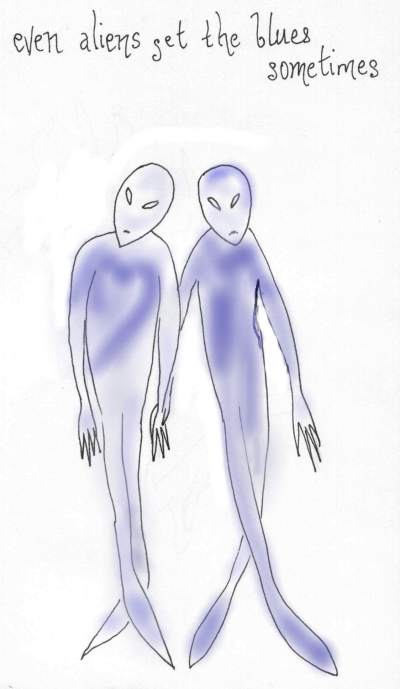
I'm as guilty as the next person, I suppose. I actually enjoy the theories promoted by the poor, mad former star sportscaster, David Icke. He is convinced that all the world's powerful government officials are descendents of space aliens, of the "reptilian" sort, who have the ability to shift their shapes and morph in and out of reptilian form.

But, I also realize that when I indulge in believing in conspiracy theories, I also assume a kind of intense passivity. How can you fight not one, but a horde of reptilian aliens?

In a time of information overload, agendas, vested interests, security fears, propaganda, disinformation and misinformation, it is more important than ever for journalists to have a clear sense of what their mission is, and why they are doing it. If they are simply selling papers and writing to reinforce the owner's political aspirations, fine. They need to understand that, though -- and question their own motives DAILY. Worse than a populace that believes everything it reads, is a populace that believes nothing and begins to become alienated from itself.


Friday, May 16, 2003

IS IT A UTOPIA, OR ARE YOU JUST "PLUGGING INTO 'THE MATRIX'"?

"... and there might lie the secret of the first "Matrix": beyond the balletic violence, beyond the cool stunts, the idea that the world we live in isn't real is one that speaks right now to a general condition. For the curious thing about the movie was that everybody could grasp the basic setup instantly. Whether it occurs in cult science fiction or academic philosophy, we seem to be fascinated by the possibility that our world might not exist. We're not strangers to the feeling that, for much of our lives, we might just as well be brains-in-vats, floating in an amniotic fluid of simulations. It doesn't just strike us as plausibly weird. It strikes us as weirdly plausible." --- Adam Gopnik, "The Unreal Thing: What's Wrong with the 'Matrix'?" The New Yorker 19 May 2003, 73.

I've been looking forward to the sequel to "Matrix" for several years now. While I wasn't a complete Matrix "Neo-phile," I have to say that I completely grooved on the basic premises. I love the whole idea that I remember first encountering in "The Wizard of Oz" as Toto pulled back the curtain. Ahhh -- the Wizard!! all smoke and mirrors!!

For the last 15 years or so, I've been an active devotee of postmodern literature and philosophy -- some of the basic premises are
-1- Reality is a construct
-2- Characters and identities are invented
-3- Narratives are multiple, potential explanations for the same thing are many
-4- Chaos is liberating -- what looks like destructive energy is, in many ways, dionysian -- meaning transformative, regenerative, liberating

There are many more bullet-point key points, but these are my favorites. For the last ten years, I've also been quite interested in Tibetan Buddhism -- as a philosophy (not as a religion per se). I have to say that the idea of training one's mind to realize that what we see is an illusion -- the confused perception called "samsara" --- is a world of phenomena directly created from our mental activity.

Conversely, if we train our minds to envision positive realities, can't we then begin to construct such utopias? If there's one grand theme in my life, this seems to be it. Unfortunately, I haven't mastered the art of maintaining a clear utopian vision for more than about 10 or 15 minutes at a time.

Writers and political theorists such as Machiavelli, Sir Thomas More, Michel Foucault, Jeremy Bentham, as well as organization and leadership gurus all seem to maintain a vision of a better world. Although I don't agree with all the aspects of their visions, they do give me something to think about. I start to see the relationships between the individuals, institutions, resources, and ideals.

Artificial Paradises: Are they Utopias or Matrices?

When Charles Baudelaire wrote his seminal work, "Les Paradis artificiel" in 1860, he was describing how the mind constructs an "artificial paradise" when under the influence of the mood-altering substances of his time: wine, hashish, opium. It was his exploration into the subtle relationships between how a person perceives the world and how or under what conditions such a viewpoint changes.

Reality is how you perceive it. Nothing more, nothing less. That is the clear implication.

More than a century later, Jean Baudrillard published "Simulacra et Simulation" (Simulacra and Simulation), which suggests that we know and understand our world, not through real or authentic experiences, but by means of the blizzard of signs, images, and manipulated appearances that surround us. Perhaps this is a natural consequence of industrialization, urbanization, and communications technology. Nevertheless, the consequences are far-reaching -- through what Baudrillard calls a "Disneyfication of the imagination," we inhabit a world comprised completely of false constructions, life in one of the Walt Disney Worlds, which are so "real" that they begin to supplant and replace the "real."

I suspect this is not new. Aren't all attempts to tightly control a society a sort of the same thing? Sir Thomas More's Utopia was an island that existed in no real dimension -- hence the term "utopia" from the Greek "ou" meaning "no" and "topos" meaning "place." How different is that from the basic premise of "Matrix," where people's brains are plugged into a big virtual reality generator that creates their own experience?

The key issue is not that reality is a construct. It is, who is constructing our reality for us? And -- this is scary ... why? What are the motives? I can live with entertainment reality construction of a theme park. I understand the worlds of a shopping mall, and the reasons for those realities. It's the brave new world stuff that makes me nervous. Worse is the idea that I'm not even aware of when my perception has been manipulated.


Wednesday, May 14, 2003

INTO UTOPIA: Learning and Technology Outside the U.S. -- Azerbaijan, Part 4
Low-Cost Business and Training Centers (the BIT-GUT approach)


Conceptually, it's simple. Further, everybody likes it. It's the idea of making information available through a digital library so that remote locations can share information.

The first steps are usually not too difficult. A website can be made for each entity. Weblogs can be set up.

The toe has entered the water. The tentative first step has been made. This is all very good. However, without good project management and a great deal of coordination, this first outing in the cool web-waters can become a grisly shark-fest.

To avoid a complete disaster, the following Business Information & Training Guidelines for Unified Tasks (BIT-GUT) should be followed:

BIT-GUT Rules:

-1- SUFFICIENT SERVER SPACE: Make sure that each participating location or entity has a separate website with ample room on the server for uploading the documents they would like to make available.

-2- STANDARDIZED FORMATS: Make sure that all documents that the entities will be making available are available in the same formats. Ideally, they should be available in three versions:

-a- pdf file (be sure to include a link to Adobe Reader downloads). Ideally, this is a "lite" version, with optimized graphics for quick download. Try to zip the file if possible. Also include a link to zip programs.
-b- html format
-c- text-only (or graphics minimized) "print friendly"

-3- TEMPLATE APPROACH TO CATALOGUING AND INDEXING ARTICLES: Be sure to agree upon a classification scheme so that information can be effectively organized.

-a- Standardize labeling / classification scheme for articles. An example would be to list them by SPONSORING ENTITY // CATEGORY // AUTHOR'S LAST NAME // SPECIFIC ARTICLE NUMBER. For example, an article on honey bees hosted by ACDI-VOCA in Khachmaz, Azerbaijan written by Buzz Hunnicomb would be listed this way: ACDI-VOCA // AG-TECH ASSISTANCE // HUNNICOMB // 1
-b- Make sure that every sponsoring organization develops a consistent index page for their online catalogue.

-4- UMBRELLA ORGANIZATION PORTAL: An umbrella organization or entity can bring together the virtual libraries of the sponsoring entities by means of an umbrella information portal." This portal would consist of the following:

-a- Links to individual article, listed by category and by author
-b- Links to the information index pages of the sponsoring organizations

-5- SERVER CONSIDERATIONS: Great care should be given when selecting a server. Linux offers many advantages, one being the use of php. Since open-source courseware, weblogs, and other software contain php, it is ideal for certain kinds of collaboration. In addition, Linux servers are spared the some of the problems of others (namely NT).

-6- INFORMATION SHARING VULNERABILITIES: It is a good idea to screen all articles before linking to them in the main portal pages. Please keep in mind that since the hosting functions are decentralized, there is less vulnerability to losing information. Nevertheless, it is a good idea to have mirror space via a free (or low-cost) web-hosting service for the "Lite" and text-only versions.

-7- SYNCHRONIZE WATCHES, THE RACE IS OFF!! Be sure to have monthly deadlines & clear milestones in order to maintain an orderly information flow.
-a- 10th of the month: all new articles uploaded, links updated on sponsoring organization pages, and "lite" versions uploaded to the mirror sites.
-b- 15th of the month: send links to UMBRELLA ORGANIZATION
-c- 25th of the month: all articles and links reviews and approved, links updated on UMBRELLA portal page
-d- 30th of the month: press releases to local news media announcing new resources now available

-8- TRAINING WEB-ENHANCED AND INTERNET-GUIDED: Training materials can be managed in the same way. Training documents can fall into the following categories:
-a- Syllabi and course outlines
-b- Course lecture notes
-c- Course readings
-d- Student activities (worksheets, collaborative exercises, review tests)
-e- Evaluations

Following the BIT-GUT recommendations, it's possible to coordinate even the most distant sites, and the most diverse technical and training information.

BIT-GUT = BUSINESS INFORMATION & TRAINING GUIDELINES FOR UNIFIED TASKS


Saturday, April 26, 2003


On Asymmetrical Love


On Asymmetrical Love (ahem, "warfare")


I've been reading Roger Barnett's Asymmetrical Warfare, and while it is quite intriguing, I can't help but think that his idea is a paradigm that applies to much, much more than war.


The basic premise is this: you can't win, no matter how powerful, technologically advanced, virtuous, righteous, whatever -- if there exists a state or condition of asymmetry.


Asymmetry comes in many forms, but can be described as vastly mismatched or incongruous primary attributes such as:


  • Size
  • Level of technology
  • Strength of forces
  • Willingness to win "by any means necessary" (and attendant ideas on ethics)
  • Beliefs about the "proper" use of violence
  • Ideas about how one becomes a hero or a martyr
  • Definition of "war"
  • Definition of "valor" and cowardice
  • Willingness to put non-combatants and their property in harm's way


I think we can all see what asymmetrical war is all about -- the larger side can't seem to maintain its invulnerability even though they seem to have the clear advantage -- simply because the enemy is playing by a different set of rules. Chechnya comes to mind. And, of course, 9-11 is the most stunning example in current American consciousness.


Asymmetrical war can be a mess.
It successfully engenders rampant paranoia.


But hey, it's great for the people who profit from instability. It's a perfect opportunity to hand out little trinkets & medals for the "martyrs" and "heroes" -- usually young conscripts -- whose families have no choice but to console themselves with the idea that the squalid sacrifice actually meant something. Yeah. Sure.


What do I know? I'm not even describing war. I'm describing love -- at least the way I've come to understand it over the years.


Asymmetrical Love.
Predominant Characteristics:


  • Hopelessly unrequited
  • Mutual incomprehension
  • Conflicting ideas about what constitutes appropriate behavior
  • Rigid notions of what constitutes "love"
  • Willingness to use tactics that the other considers unconscionable
  • Viewing the actions of the other through a distorted prism, thus misinterpreting actions, misattributing motive, over-personalizing the situation, or remaining detached and/or unaware of important cues
  • Willingness to involve others, putting them in emotional harm's way
  • Stalking (!) but being unaware of one's stalking behavior
  • Intrusive and prying -- driven by the need to find the secret weakness that will allow one to "win the battle"


Asymmetrical love is, like asymmetrical war, unpleasant.


It's a shame, because most of the world's great tragic love stories have, at the very core, some sort of asymmetrical love drama. Actually, come to think of it, most of the world's great comedies (technically, a comedy ends in marriage), involve the happy resolution of an original asymmetry.


Well. If only real life were so neatly packaged. Unfortunately, Shakespeare's comedies only feed asymmetrical love, especially as it starts veering off the road and plunging straight into erotomania.


Most commonly, asymmetrical love is fairly benign. It has to do with the asymmetries inherent in the tension between


LOVE THAT IS REAL VS. LOVE THAT IS NOT REAL


Symmetrical love:
o- it really exists and is reciprocated
o- both parties exist
o- both parties know each other
o- codes of ethics, behavior, and values are shared
o- death is not fetishized


Asymmetrical love:
x- it is not a love that is reciprocated
x- it really exists, but only in the mind of one of the individuals
x- both parties may or may not exist
x- the parties may not even know each other
x- codes of ethics, behavior, values are not only not shared, they are not even communicated
x- death is fetishized (as are aberrant behaviors in general)


As a person with dove-nik leanings, yet a realist, I would seek to find diplomatic resolutions to all conflicts and misunderstandings. However, asymmetrical wars will probably always occur, as will asymmetrical love. That's sad.


toujours,
susan


REALITY MAPPING WITH T-MOBILE SIDEKICK

Susan Smith Nash


Connectivity, access, and mobility are primary problems with web-based or online education. It's pretty limiting to be hunting for connection, or lugging a laptop when what's really needed is the ability to instant-message, and to save, send, and transfer text and images -- either to one's own e-mail or to the e-mail of others.


T-Mobile and other mobile communications providers convenient and affordable plans which make these concepts attainable and real. For example, T-Mobile's Sidekick is a tiny keyboard & PDA, that also offers typical cell phone coverage with a head set. You can buy a tiny digital camera, take photos, then instantly e-mail them. It really opens real-time communication, plus provides the opportunity to collect images, date-stamp them, and save them to analyze later. Here's what seduced me -- you can get started at only around $200 (with rebate)!! (doesn't include the camera, or the $19.95 monthly fee; $39.95 if you want full voice & unlimited data transfer).

The features, and possible applications are the following:
Web browser - real surfing on on virtually all sites - can look up information and upload data to various sites

Mobile Snaphots - just attach the camera, snap a shot and send it via e-mail.

AOL Instant Messenger ™ Service - can communicate with individuals on the Buddy List.

E-Mail - set up as many as three POP3 email accounts to deliver mail directly to the Sidekick -- this allows one to make observations in real time, then e-mail them to a special e-mail account set up specifically for field observations.

Educational applications are unlimited. Here are a few ideas:

1. Research methods classes -- collecting field data for statistical analysis later. Intersection traffic

2. Project in Marketing research involving consumer trend micro-research: Taco Bell customers from 10 pm to 2 am Saturday - Monday

3. Geology field trip -- mapping the outcrop, classifying fossils that can't be retrieved

4. Botany field trip -- magnolia blossoms on a certain date in March

5. Overheard conversations in line to a new release movie

6. Political campaign poster coverage

These are just a few ideas -- I truly believe this is the new direction, especially as prices fall, and it will be possible to transfer Excel and MS-Word files via Sidekick as easily as one can through a conventional PDA, but at a fraction of the cost.

Saturday, April 12, 2003

FIRST VODKA, NOW MADONNA:
CHE GUEVARA IMAGE STILL SELLS


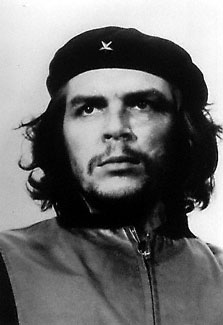
Most people looking at Madonna's most recent offering, American Life, will not recognize the visual allusion she makes in her beret, dark hair, severe expression, single red stars, military stencil distressed type font. She's missing the trademark Cuban cigar, but the average consumer will not notice.

Others will surely see the echoes of Alberto Korda's famous 1960 photo in which Argentina-born Marxist revolutionary Che Guevara, attending a funeral in Havana, wears a black beret emblazoned with a red star. Korda later complained when the famous image was used in 2000 in a Smirnoff ad to promote vodka sales. Korda, who supported the use of the image to promote such causes as the revolutionary overthrow of elitist governments or repressive regimes, vigorously opposed the use of the image to promote vodka.

In the case of Madonna, her use of the Che image strangely echoes her "remaking" of Lena Wertmuller's classic film, SWEPT AWAY, which, in the original, was a potent Marxist critique of elitism, classism, and oppression. In Madonna's hands, all intellectual content is drained away, and it becomes a pseudo-violent cartoon of Shakespeare's The Taming of the Shrew. There, Madonna (or her husband/director Guy Ritchie) ham-handedly legitimizes and/or attempts to eroticize violence toward women. It's familiar territory for Madonna, who has borrowed heavily from the gay underground, including the "rough trade" and sado-masochism scene. However, in the original there are true questionings of society, culture, and human nature. Madonna consistently presents a significantly mainstreamed version, palatable to consumers unaware of its provenance.

As usual, Madonna packages a product that promises to be an investigation of culture, gender roles, societal attitudes, cowboys, dance, fashion, and war. As usual, the promise is empty, and the package is surprisingly devoid of intellectual content. Transgression turns into bait and switch; an echo of sensationalized reality television. The product promises to be a tasty, bite-sized nugget of the taboo, but instead, is a sack full of junk food.

The taboo is always fodder for commercialization, particularly when it deals with sex and violence.

The photo of Che Guevara, already turned into consumer candy, devoid of any traces -- fervent, ironic, or otherwise -- of Che's speeches which hammered home the message that "consumerism leads to bestialization," has a 40-year history of appropriation. It has, by now, lost much of its potency -- not simply for its use in vodka ads, but also by the absurd self-stylings of individuals who claim to be fighting for the people, as they line their pockets with the resources of the poor. Saddam Hussein comes to mind, as does Madonna, yet again.

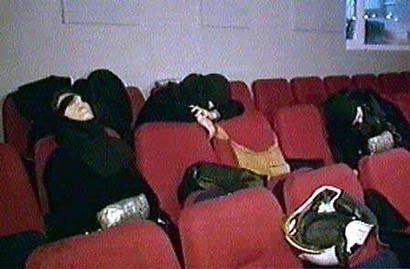
For a truly unsettling fashion statement, I would recommend taking a look at the offerings from the 2003 Russian Fashion Week, featuring the designs of designer Polina Filenko. She creates black evening dresses with dark hoods that evoke the image of the Chechen "black widows" who wore black veils and dresses as they sat in the Nord Ost theater, their hands on bombs wired to blow to oblivion themselves and the theater-goers they had captured. With her creations, Filenko creates a complex image that disturbs on many often-contradictory levels. It is fashion that forces one to think. http://story.news.yahoo.com/news?tmpl=story2&u=/030412/242/3rztd.html


Surprisingly, with her beret, Madonna manages to undermine her reputation as a women who metamorphosizes herself to stay on the cutting edge. The old beret and red stars are passe. Foolishly enough, her image will probably be misinterpreted as being vaguely patriotic.

Give Madonna a cigar.


Monday, April 07, 2003

WHIPPED UP INTO A FRENZY OVER WAR

The world seems to have gone mad with blood lust.
Longshoremen and war protesters are being shot with rubber bullets. It's harmless the local law enforcement asserts. Nevertheless, I'd hate for a rubber bullet to hit me in the eye or in the temple.

The longshoremen are not in favor of the war.
The group lined up on the hill near them are fervently pro-war.

What does it mean? Being "in favor" or "not in favor" strikes me as sort of meaningless -- we, as the cannon fodder of the world, have to recognize that all these emotionally compelling representations about war do nothing but get us caught up in waves of emotion. Waves of emotion blind us to the point that we think that we're exercising freedom of choice. We think we are in control -- that we're running willingly to war, or away from war.

Either way, we're "idiotas utiles" -- useful idiots.
We're cannon fodder with a smile or snarl on its face.

I'd rather, like Melville's Bartleby the Scrivener, choose not to.
If we end up in the same place, we might as well spend our time in the pursuit of slothful delights.

But offer that avenue to someone and see what happens. You'll be amazed at how you'll be spurned. You'll be called a "dead fish" and labeled as having a "lack of affect." People will treat you as though your expressionless were some sort of contagion. No one wants to go down your chosen path, however attractively it promises an absence of all pain.

Not believing in the "grand cause" is tantamount to saying that one doesn't believe in love.

True enough, the self-preserving part of ourselves would prefer to disavow love and any other messy passion that threatens to shred the flimsy fabric of our hearts.

Heaven forfend that we start believing that the object of our passion -- be it a flag or a "fair one" -- the one great animating idea of our existence, should be pursued, "damn the torpedoes."

Wow. My words certainly sound callow and uninspiring.

No one wants to believe that the passions of us, the little people, are farcical and simply make us easier to manipulate.

However, indifference is inadequate armor. Simply refusing to care will not guarantee you a place on the lifeboat to Disneyland or Universal Studios.

On the news today, there was a photograph that was beamed around the world. Four Marines were carrying their mortally wounded buddy out of a firefight. The expression on the face of one of the guys haunts me. His glasses were a bit askance, his face sooty, a little fuzz on his upper lip testament to the fact he had been up for at least 24 hours. He looked to be around 19, but the eyes were like no 19-year-old I've ever met. That image will bother me for a long time. So will the realization that the photojournalist risked his life to capture that shot. We see the truth about human courage -- in front of, and behind the camera.

If only they had been protesters. If only those had been rubber bullets. But, a society does not glue itself together without collective passion. I'm desperately trying to find that "middle path" of absolute numbness, but all I feel is sadness mixed with sodden, impotent, wet-gunpowder rage.
Headline News

COALITION FORCES TO INSTALL MCDONALD'S IN BAGHDAD, THEN CINNABON

ARMY CORPS OF ENGINEERS DRAFTING PLANS FOR FOOD COURT AT BAGHDAD INTERNATIONAL AIRPORT

SARS VICTIMS SEE VISIONS OF NEW TECHNOLOGY, UNDERWATER BREATHE-THROUGH-YOUR-SKIN "GILL SUITS"
For weeks, Chinese scientists hid the outbreak of SARS, not because they were afraid of a worldwide outbreak of the deadly disease, but because hallucinating SARS sufferers are revealing startling visions of future scientific breakthroughs. The Chinese want to keep the potentially billion-dollar scientific revolutions for themselves. Feverish, hallucinating SARS victims say they are being transported to the future, where they shown plans for new material -- a thick, spongy rubbery material -- that is formed into something resembling either a body stocking or a scuba diving suit. Once you put on the full-body suit, you find you can breathe without breathing -- your new "skin" breathes for you!! According to the SARS-afflicted time-travelers, the new suits will enable the population to live underwater, and on the floors of the ocean. New cities will be constructed on the ruins of old, drowned cities -- Atlantis, Alexandria, and many more. Eventually, people will not live on the surface -- they will live underwater, where they will never have to fear melanoma or sagging, wrinkly, sun-damaged skin.

NOSTRADAMUS' "CELESTIAL VENGEANCE" FOR FIGHTING IN THE NAME OF RELIGION -- COULD THIS BE SARS?

Saturday, April 05, 2003

SADDAM'S PSY-OPS:
SADDAM PUTS U.S. SOLDER UNIFORMS ON STRAY DOGS AND CATS


You may have read that tyrannical Iraqi dictator Saddam Hussein purchased U.S. military uniforms to play some of his dirty tricks.

All true. What they didn't tell you was that he ordered them doggy-size! These tot-sized Army and Marine camouflage-patterned jackets, pants, and little caps were for the stray dogs and cats of Baghdad. After dressing up the unlucky pooches, his psy-ops units treated them to a "MARTYR'S LAST MEAL" of sheep bones and grilled chicken.

Then they were herded into the windowless secret police trucks usually used for political prisoners on their way to Saddam's private torture cells.

After releasing the dogs and cats throughout residential Baghdad, at least a dozen pick-up trucks with loudspeakers mounted on top traveled through the streets blaring the message to watch out for U.S. devils who can morph themselves into dogs and cats.

Poor dogs and cats! Imagine the impact on the citizens of Baghdad who strongly believe in demons -- so much so that you'll always find that they place charms and amulets in their homes to protect themselves against the "evil eye." Suffice it to say that the little uniformed dogs and cats met a grisly end. In fact, a few of the pint-sized jackets were spied, blood-stained and nailed to front doors, accompanied by an ear, paw, or tail.

Suicide trucks, using women and children as human shields, faking surrender -- and, now this. Consider yourself lucky that you were not born a dog in Saddam's Iraq.

Friday, April 04, 2003

SUGGESTIONS FOR ALTERNATIVE PSY-OPS

I just read an article in the Washington Post by a reporter embedded in a Psy-Ops unit in Baghdad. Honestly, their tactics seemed laughable. Broadcasting SURRENDER NOW OR YOU'LL DIE seems a bit silly when you consider that Saddam Hussein virtually promised that the entire population is comprised of willing martyrs.

It would be quite interesting to be there. I would have my own suggestions for effective psy-ops. First, we have to identify the goals. Do we want the enemy to surrender? Or, do we want to feed their lust for death and martyrdom? Announcing you're willing to be a martyr seems like a dumb idea. Think about it -- with any skill at all, you can convince the suicide forces to detonate a bit early, or late, or in the wrong place. They still get to be martyrs, but they just don't take anyone with them. We see this all the time in Israel and the West Bank. If it weren't such an obscene desecration of the very idea of the sanctity of life, it would be an almost Southern Gothic Classic of tragi-comic and grotesque humor.

If I were managing psy-ops for a rag-tag, sleep-deprived and hungry army, dead-set on martyrdom, I'd play to their hankerings for the classic "blaze of glory" Samson motif. If you recall, Samson was the Old Testament character who vindicated himself at the end of his life -- after being stripped of his strength (by Delilah) and blinded -- he used his newly regained strength to destabilize the pillars of the temple. When the temple collapsed, he died, but so did a legion of his oppressors.

1. The SAMSON TRAP. Pretend to have a contingent of your elite fighters in a large temple-like building. It's best if it's a holy sort of building; hence the sense of outrage, desecration, and contamination-by-infidel will be the most unsettling. Somehow intimate that, gee, wouldn't it be wonderful to trap all the infidels inside, then take down the whole building? Of course, the idea that the troops are in there is an illusion. So, they take down the building -- with only themselves in it.

2. SUICIDE TAXI: Set up decoy checkpoints. Make them look like "soft targets" -- put up a tent, make it appear that it's an officer's planning tent. Put cut-outs of Marines in the tent, so there are shadows and silhouettes. When the explosives-rigged suicide taxi detonates right up practically inside the tent, no one is hurt, except the suicide taxi-driver whose sad soul has been liberated from the nasty earthly sphere. Losses: canvas and cardboard. Some clean-up time required.

3. MY GOD IS BIGGER & BADDER THAN YOUR GOD. If the Humvees are equipped with big speakers, why waste them on ineffectual tripe in which you put together a recording that begs all decent, hardworking aspiring martyrs to humilitate themselves in front of their felllow jihad-seekers by becoming a coward and seeking surrender (life) rather than a glorious (albeit ghastly) final blast? Come on. Even I can see that it won't work. I recommend blaring recordings of a high-pitched, shrieking male voice -- in Arabic -- doing a muezzin-type thing, but with different words. "My God is the real God The God of the Jews is the only ONE GOD. Your god is a weak, silly god. Your god is homosexual. Your god is out of date. Your god rubs sticks together to make fire. Our god is strong and righteous and good. Our god rides a horse and speaks English. Your god is out-of-date and useless. Your god does not protect you from tyrannical rulers!" The idea would be to stir them up so much that they become angry. With hot tempers come atrocities. Push them, trick them, deceive them so that they become enraged and blind with passion. They take themselves out. Their relatives will probably figure out what happened. However, by that time, it will be 20 later.

4. WACO IN BAGHDAD. Pump up the buildings with highly flammable gas. Then, throw in flares. Or, American cigarettes and nice, shiny lighters. The martyrs will do the rest for you, and for themselves.

Well, that's all for tonight. I had contemplated dressing up dogs and cats in Saddam Hussein outfits, then inserting shreiking, ululating women who would say that the big American demons had transformed themselves into little demons and were on the point of morphing back into their super-warrior status. I rejected that as unworkable. What if the stray dogs you want to dress up have rabies?

I also rejected the idea of announcing, through Humvee-mounted loudspeakers, that the Americans are devils. The announcement would go one to say that the Americans not even human. They are descendents of space aliens who can morph at will into other dimensions and manifestations, and that they're on the verge of morphing into giant 30-foot owls who hunt at night and scoop up with their huge talons people as though they were field mice.

Today's journal has wiped me out. Au revoir!! & good night :-)

Thursday, April 03, 2003

PING-PONG MEDIA WARS

The media wars are making me feel like a ping-pong ball, smacked around, back and forth, between the no-holds-barred spin going on in this "brave new world" war.

I suspect I'm not any different than anyone else. I'm an American. Therefore, any positive reports help me reinforce the idea we're liberating oppressed peoples from tyranny, and ridding the world of a kingpin figure who traffics in and subsidizes terror. That's what I want to believe. Granted, it's utopian. It's also pretty pollyanna-ish and a stance that's hard to maintain emotionally when one sees scared teenage soldiers dealing with unexpected guerrilla war tactics, and when one sees pictures of the victims of a war. Like all wars, this one is beastly and ugly.

I grab the remote control, change channels. A paddle of a different orientation smacks me across the table. I ping-pong to the other side as I am assaulted by the images of entrails, half-blown out brain pans, decapitations, dismemberments, wailing and devastated mothers and fathers, all accompanied by an angry voice that accuses us Americans of atrocities, of cruelties against the defenseless, of being evil, of being animals, being devil-spawn. It's like listening to an old Cold War-vintage anti-American propaganda film.

This seems extreme. However, I can sympathize with the individuals who have lost their loved ones. I see their point of view. Suddenly, I'm overwhelmed with shame, nausea, and a deep sense of humiliation for having intruded on someone's moment of grief.

Fundamentally, I'm apolitical. I just want to have a job, live in peace with my family and friends, and think that I'm somehow contributing my part in weaving the fabric of society -- the warp and woof that keeps us all together. I'm probably like everyone else.

Like everyone else, I find it tempting to succumb to the temptation of feeling self-righteous, morally unimpeachable, completely correct in my "take" of the world. Maybe it's a rather cheap sort of self-justification. I don't know. All I know is that such a mindset usually calms me.

Not now. I'm vulnerable to both arguments -- perhaps because the media representations are very hard-hitting, thanks to skillful editing and the ability to construct a film narrative that is very effective. Hollywood is more than 100 years old, and the lessons learned there have been seared into the consciousnesses of film editors and producers worldwide.

My problem is that I go along with the argument -- even if I do not quite believe either side. Both sides are presenting a very two-dimensional view of reality. The world is more complex than jingoistic cheerleading or condemnation.

However, what sticks to my consciousness like feathers to tar is the idea that I'm a monster for being an American.

I don't want to believe it, but I suffer a kind of existential guilt that is triggered by media rants that are no different than hate speech. (By the way, isn't that illegal?) I start questioning myself, my motives, my affiliations. I begin to feel shame, helplessness, despair. Self-loathing is not far behind. Should I believe the extreme media? Am I complicit in a huge conspiracy? Is this a scary high-tech, sci-fi war that has as a goal, a new brand of genocide? Am I nothing more than a greedy resource hog who feels completely justified in doing whatever is necessary in order to satisfy my narcissism?

Of course not. I must regain my perspective.

What does it mean to me to be an American? What are my core values? What do I believe? What is it about being an American that makes me so relentlessly utopian? Why do I so fervently believe that reform can help liberate other little guys (like me) so that we all have access to education, clean water and food, medical care, and a chance at dignity? Why am I so passionate about our core values of democracy, freedom, and our unalienable rights: the pursuit of life, liberty, and unhappiness?

Perhaps the fundamental tragedy of this ping-pong business of media wars is that it doesn't lead to true introspection. Instead, we're either feeling good, like we've taken the tough, but essentially correct moral high road -- or, we're feeling the deepest, most terrible kind of existential shame, yet helpless to do anything at all to intervene or "correct" the situation.

We have to hold fast to core values. Examine what it means to be an American. Why do (or did) people emigrate here? Is it from pure greed and the desire to live in a credit-card fueled vast Disneyland of a country? Or, is it for the ability to sleep at night, and look your fellow human being straight in the eye and maintain human dignity?

Here is a poem I wrote in response to these thoughts and feelings. It is supposed to be accompanied by music -- so don't judge it too harshly!! Okay, as a stand-alone poem, it is, undoubtedly doggerel.... but I wanted to speak to what I believe are core values that are quickly being lost.


an american anthem
by susan smith nash


**** **** **** **** **** **** **** ****

as you talk to your neighbor, do you live in fear?
as you pray in your churches, can others hear?
you are free, you are strong, you have dignity
because of lives, of blood, and our history

as you look in the night, do you see that dawn is near?
is your heart still beating for what you hold dear?
you are here, you have hope, you have liberty
because of minds, of hands, and the absence of tyranny

we are kind, we are brave, we are gentle souls
we are sons, we are mothers, we have many roles
many voices, many views, glorious diversity
we Americans, independents in blessed unity

don't forget you bear the name, American,
sing your name loud and proud like a national hymn
remember to use before you lose your cherished values
and spread the news far and wide that you refuse to be abused

when we talk to our neighbors, we have no fear
when we pray, we shout out so others hear
we stay strong, we stay free, we go on with dignity
thanks to lives and blood, shed in blessed unity


CHORUS:

Hand in hand and heart to heart
We know the place where we have to start;
Step by step from shore to shore
We must give of ourselves and then give more;
Brothers, sisters, fathers, and mothers
Hear our pledge to care for one another
Restore our spirits, so glorious and free
This land we love and our liberty.


© 2003 by Susan Smith Nash

Well -- so much for tonight's post. Let me know if you like it.
smithnash@earthlink.net


Tuesday, April 01, 2003

British marines complain the American soldiers are "cowboys." Europeans accuse President Bush of being a "cowboy."

Cowboy? This is bad? Reading the headlines led me to contemplate what it means to be a cowboy -- in Oklahoma, in the world.

Apparently there's a difference. I had no idea until the war, and epithets came hurling, primarily from Europe. This surprised me. In France, I had found that cowboy boots are (well, used to be) coveted fashion statements. In Switzerland, a very fashion-forward Turkish physician friend of mine doted on his own cowboy boots. But things seemed to have changed. "Cowboy" was the one word that seemed to be accompanied by the most venom and disdain. That absolutely floored me -- as an Oklahoma, the word "cowboy" is in no way insulting, unless, perhaps it comes accompanied with "redneck."

"Cowboy" is bad? I was still incredulous as I gazed into my closet and looked fondly at my cowboy-inspired high-heeled boots, my bolo ties with double-terminating quartz crystals mounted in the center, and my turquoise-encrusted silver jewelry. "I Wanna Be a Cowboy" -- a campy Adam Ant or Milli Vanilli-type of song from the late 80s floated through my head. It was one of my favorite songs to do aerobics to, and as I jumped to the beat, I couldn't help but think of my favorite cowboy, the Lone Ranger. The Lone Ranger was a marvel of sartorial swish (a la cowboy) and emotional restraint -- always leading the force for the decent and the upright. Granted, he called his Indian sidekick Tonto, which means "fool" in Spanish. But, Tonto slapped him right back with "Quien No Sabe," which means, loosely, "the guy who knows nothing" or just basically "bonehead."

Cowboys always seemed a bit boneheaded to me. Maybe it was because they were always so plain-vanilla and transparently virtuous. How dull. There were always outlaws to catch, but you couldn't call them "cowboys" -- they were simply outlaws. Oklahoma, especially during pre-Statehood days, was a lawless place of outlaw hideouts, shell-shocked and landless ex-soldiers. The only way they could make a buck was to hire on as a mercenary soldier for the U.S. army -- or prey on the migratory herds -- the settlers heading west for California gold or a Mormon garden of polygamous delights. There were also the return trips -- the trains laden with gold, the Pony Express with hauls of paper money and gold -- gold, gold, gold. But -- these were outlaws, not cowboys!

In Waurika, Oklahoma, there is small museum honoring the Chisolm Trail, a cattle trail used to move longhorns, black angus, and other beef cattle from Wichita Falls, Texas, to Wichita, Kansas. Approximately 3 miles from my childhood home, a historical marker indicates where the "Dave Blue Trading Post" once stood, approximately a third of the way along the trail. In visiting these places, one comes to realize that the historical cowboy was not a hot-head. You had to be precise, skilled, and patient to take a herd of 1,000 or so head of cattle on a 3-month trek. Along the way, you'd eat beans, cornbread mush, lard, meat, raisins and dried apples, washed down with hot black coffee. You'd carry a gun, but it was for self-protection or bagging dinner. At age 30, you'd look 50, with sun-wizened features, thin muscles like ripcord, and legs already bowed by too much time in the saddle.

Now, the cowboys definitely didn't have much time with women. They also didn't carry much alcohol with them. Perhaps that's where one could say they were hot-heads -- I don't know. But, what do you expect? Sailors in port, if you want my opinion. Some gold coins jingling in the pocket had to lead to a tingling-all-over feeling -- get "lickered up" and head for the brothel. At least, that's the red-blooded approach. Like sailors, though, they certainly did spend a lot of time with the guys, assiduously avoiding the company of women and the middle-class incarceration of matrimony and squiring offspring.

Hence, my favorite view of cowboys -- and, what I always thought was the prevailing one. Cowboy: hard-working guy on a horse, the embodiment of earthy, simple, self-reliance. Or, alternatively, Cowboy: campy fashion statement, all decked out in fringe, embroidered roses, long Custer-like hair, shiny silver spurs, intricately tooled leather boots. For me, it could be either Buffalo Bill or king of the gay rodeo. In any case, an innocuous fop, a campy exaggeration of maleness and inarticulateness that, on a good day, masquerades as stoicism.

Even our cowboy-inspired icons and mascots have that double-edged element -- cowboy as hard-working, simple upholder of rugged, honest work; or, flashy, fringed, tinkling like a windchime as he walks, pearl-handled stud. The earth-god and his campy, frippery-dripping antithesis.

Neither corresponds to the Scary Cowboy the Europeans seem to know and despise. Wow. What film are they watching???? Tombstone? Doc Holiday? Ma Barker and her boys? Billy the Kid? Belle Starr? Hey. These are outlaws, not cowboys!!! If they have any connection to the bovine fleet, it is only as cattle rustlers. Cattle rustlers were outlaws, not cowboys!!

One of these days, someone will have to have an International Conference on Cultural Cowboys and attempt to straighten out the wrong-headed mythologizing. Or, the reporters could come to Oklahoma City and visit the Cowboy Hall of Fame and bore themselves silly looking at all the accoutrements of cattle behavior modification -- a hundred varieties of barbed wire, a myriad of branding irons and patterns, hand-made saddles, spurs, and saddle blankets.

The next time some European suggests that hot-headed, unconscionably violent, uneducated behavior is "cowboy" and intractably American, I'd like to refer them back to other cultural stereotypes -- Roundhead, anyone? a scorched-earth Viking "were"? Or, perhaps a football hooligan....

Reductive labels used to insult someone always take the fun out of something. I prefer the stereotypes to maintain their prismatic, polychromatic glitter, with all the ambiguities and refractions of meaning and signification that accompany an entity that is both ultra-macho and ultra-queen, both pedantically dull and infinitely ironic.

Ahhhh, cowboys! How I love your swish and swagger!